
This whitepaper provides a comprehensive, technical dissection of the Mystake casino ecosystem, accessible via https://mystake7.net/. Aimed at analytical players and tech-savvy operators, it delves beyond surface-level reviews to explore the platform’s operational mechanics, from the Mystake app’s deployment to the cryptographic nuances of its login system and the mathematical underpinnings of its bonus economy.
Before You Start: Prerequisite Audit
Engaging with Mystake casino requires pre-engagement due diligence. Conduct this audit:
- Jurisdictional Compliance: Confirm online gambling legality in your region. Mystake operates under a Curacao license, which may have territorial restrictions.
- Device & Network Readiness: Ensure a device with updated OS (iOS 13+/Android 8+) and a stable, high-speed internet connection for optimal Mystake app performance.
- Financial Instrumentation: Prepare verified payment methods. Mystake supports fiat (Visa/Mastercard) and cryptocurrencies (BTC, ETH, USDT), each with distinct transaction protocols.
- KYC Documentation Portfolio: Have government-issued ID, proof of address, and payment method ownership documents digitized for swift verification, a critical step for unimpeded Mystake login and withdrawal.
- Risk Management Framework: Establish personal loss, deposit, and session time limits before initiating play. Understand the responsible gambling tools embedded within the Mystake casino interface.
Registration: Account Initialization Sequence
The account creation protocol is a linear process designed for minimal friction:
- Access the primary domain or Mystake app.
- Initiate the sequence by clicking the ‘Registration’ vector.
- Input core credentials: email (acts as primary key), a strong password (12+ characters, mixed case, symbols), and select base currency (irreversible post-registration).
- Ingest and agree to the Terms of Service and Privacy Policy—critical for legal compliance.
- Authenticate the email address via a time-sensitive link (TTL: typically 24 hours) to activate the account and enable full Mystake login capabilities.
Mobile Infrastructure: The Mystake App Deep Dive
The Mystake app is not a mere responsive wrapper but a dedicated application built for performance and security. Its architecture differs by platform:
- Android Deployment: Due to Google Play Store restrictions, distribution is via APK from the official site. Installation requires enabling ‘Install from unknown sources’ in device security settings—a one-time trust operation. The app uses certificate pinning to mitigate MITM attacks.
- iOS Deployment: Available as a web app (PWA) or through alternative app stores, leveraging Safari’s service workers for offline functionality. Native iOS app distribution may require profile installation guidance from the support team.
The app’s state management ensures game progress is synced via secure tokens, and push notifications are used for bonus alerts and security warnings. Regular updates are mandatory for patching vulnerabilities.
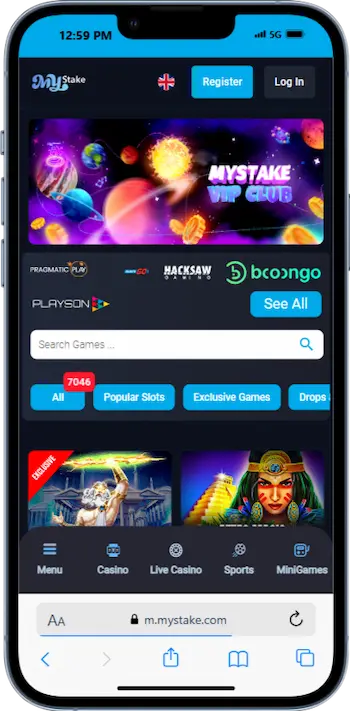
For a procedural walkthrough, reference this installation guide:
Platform Specification Matrix
| Component | Technical Specification |
|---|---|
| Licensing Authority | Curacao eGaming (Master License No. 365/JAZ) |
| Game Engine Providers | NetEnt, Evolution Gaming, Pragmatic Play, Play’n GO, Hacksaw Gaming |
| Supported Currency Protocols | Fiat: EUR, USD, CAD; Crypto: Bitcoin (BTC), Ethereum (ETH), Litecoin (LTC), Tether (USDT) |
| Mobile App Framework | Android (Native/Kotlin), iOS (Web App/PWA), Cross-Platform WebView |
| API & Integration Support | RESTful APIs for game feeds, WebSocket for live dealer streams |
| Encryption Standards | TLS 1.3 for data in transit, AES-256 for data at rest |
| Withdrawal Processing Architecture | Automated for crypto (within 1 hour post-approval), manual review for fiat (24-72 hours) |
| Minimum System Load | Deposit: $10 (or crypto equivalent); Withdrawal: $20 |
Bonus Economics & Strategic Calculus
Bonuses are financial instruments with attached liabilities (wagering requirements). A precise mathematical model is essential for evaluating their true cost.
Scenario Analysis: Assume a welcome bonus of 100% up to $200 with a 40x wagering requirement on slots (100% contribution). You deposit $200, receiving a total of $400 in bonus credit. The wagering obligation is $200 (bonus) * 40 = $8,000. Using the generic slot RTP of 96%, the expected loss from wagering is $8,000 * (1 – 0.96) = $320. The expected value (EV) is therefore: EV = Bonus Amount – Expected Loss = $200 – $320 = -$120. This negative EV indicates the bonus, under optimal play, is costly. However, by targeting specific games with RTP > 98% (e.g., certain blackjack variants at 99.5%, but note their lower contribution rate of 10%), the calculus changes. The effective wagering becomes $8,000 / 0.1 = $80,000 in bet amount, with an expected loss of $80,000 * (1 – 0.995) = $400, making the EV -$200. Thus, slot wagering is generally more efficient despite lower RTP.
Optimization Protocol: Use the Mystake app to filter games by contribution percentage. Prioritize bonuses with ‘sticky’ vs. ‘non-sticky’ bonus money rules and always calculate the break-even RTP: Required RTP = 1 – (Bonus Amount / Total Wagering). For the above, 1 – (200 / 8000) = 0.975 or 97.5%. Any game with RTP above this threshold reduces expected loss.
Banking Pipeline: Transaction Lifecycle
Deposits are instant, crediting via payment gateway APIs. Withdrawals trigger a multi-stage process: 1) Fraud scan, 2) KYC verification match, 3) approval by a human agent, 4) fund disbursement. Cryptocurrency withdrawals are automated post-approval, leveraging smart contracts for speed. Always initiate withdrawals from the same Mystake login session used for deposits to avoid security flags.
Security Architecture & Fair Play Audits
Mystake login employs OAuth 2.0-like token-based authentication, with sessions expiring after 15 minutes of inactivity. The platform uses SSL/TLS encryption, and the Mystake app implements certificate pinning. Game fairness is verified by independent audits (e.g., iTech Labs) of RNGs, with public provably fair hashes for crash and dice games. The Curacao license mandates regular financial and security audits.
Technical Troubleshooting: Diagnostic Scenarios
Case 1: Mystake Login Loop or Token Invalid. Symptoms: Redirect to login post-authentication. Diagnosis: Corrupted browser localStorage or app cache. Resolution: Clear cache/cookies; on the Mystake app, use ‘Clear Data’ in settings. Alternatively, the IP may be blacklisted; use a stable VPN or contact support.
Case 2: App Crash on Game Launch. Symptoms: App force-closes when loading resource-intensive games. Diagnosis: Insufficient device RAM or GPU memory. Resolution: Close background apps, update device OS and Mystake app, or switch to the web version.
Case 3: Withdrawal ‘Pending’ Beyond SLA. Symptoms: Withdrawal stuck for >72 hours. Diagnosis: Incomplete KYC or triggered manual review. Resolution: Submit all required documents proactively via the support channel in the Mystake app. Follow up with transaction hash or reference ID.
Case 4: Bonus Not Crediting Despite Eligibility. Symptoms: Deposit made but bonus balance unchanged. Diagnosis: Bonus not activated pre-deposit or territorial restriction. Resolution: Always click ‘Activate Bonus’ or enter code before depositing. Check promo terms for country exclusions.
Extended FAQ: Technical & Operational Queries
Q1: What is the backend technology stack of the Mystake app?
A1: While proprietary, common indicators suggest a Node.js backend for real-time features, with game content delivered via CDNs (Cloudflare). The frontend uses React Native for cross-platform consistency.
Q2: How does Mystake handle two-factor authentication (2FA) for login?
A2: As of this analysis, native 2FA is not mandated but recommended via email verification for each Mystake login from a new device. For enhanced security, use a unique, strong password and consider a password manager.
Q3: Can I use API keys to integrate Mystake games into a third-party platform?
A3: No. Mystake does not offer public APIs for game integration to end-users; access is restricted to licensed operators and affiliates via B2B agreements.
Q4: What is the precise algorithm for provably fair games like Crash?
A4: The server generates a seed (hashed) and the client provides a seed. Post-round, the combined seed is revealed and hashed (SHA-256) to determine the crash multiplier. You can verify this using open-source calculators.
Q5: Are there latency differences between the Mystake app and web version?
A5: The app, being a compiled application, typically has lower latency for game loading due to cached assets. The web version depends on browser performance and network jitter.
Q6: How does the Mystake casino handle GDPR or data privacy requests?
A6: As a Curacao licensee, it adheres to data protection laws. You can request data export or deletion by contacting DPO via email, though processing times vary.
Q7: What happens to active bets if the Mystake app loses connection?
A7: Bets are server-side recorded. Upon reconnection, the game state syncs. For live games, the bet stands based on the timestamp of placement.
Q8: Is there a way to automate betting strategies via scripts?
A8: No. The use of bots or automation scripts violates Terms of Service and is detected via behavioral analytics, leading to account suspension.
Q9: What are the technical requirements for streaming Mystake gameplay?
A9> Ensure your streaming software (OBS, Streamlabs) can capture the application window. Use ‘Game Capture’ mode for the Mystake app to reduce CPU load versus screen capture.
Q10: How are random number generators (RNGs) tested for table games?
A10> Third-party labs (e.g., eCOGRA) test RNGs for statistical randomness using chi-squared tests over billions of cycles. Certificates are published on the Mystake website.
Conclusion
Mystake casino presents a technically robust platform where success hinges on understanding its underlying systems—from the Mystake app’s security model to the precise mathematics of its bonus contracts. By applying this handbook’s principles, users can navigate the ecosystem with professional acumen, optimizing for security, efficiency, and informed play. Always prioritize responsible gambling practices and leverage the platform’s tools for a sustainable experience.